
The Tinsel Paradox
Why reviving America’s most glitter‑ridden junk might be the holiday fantasy we can’t afford

By S Falken
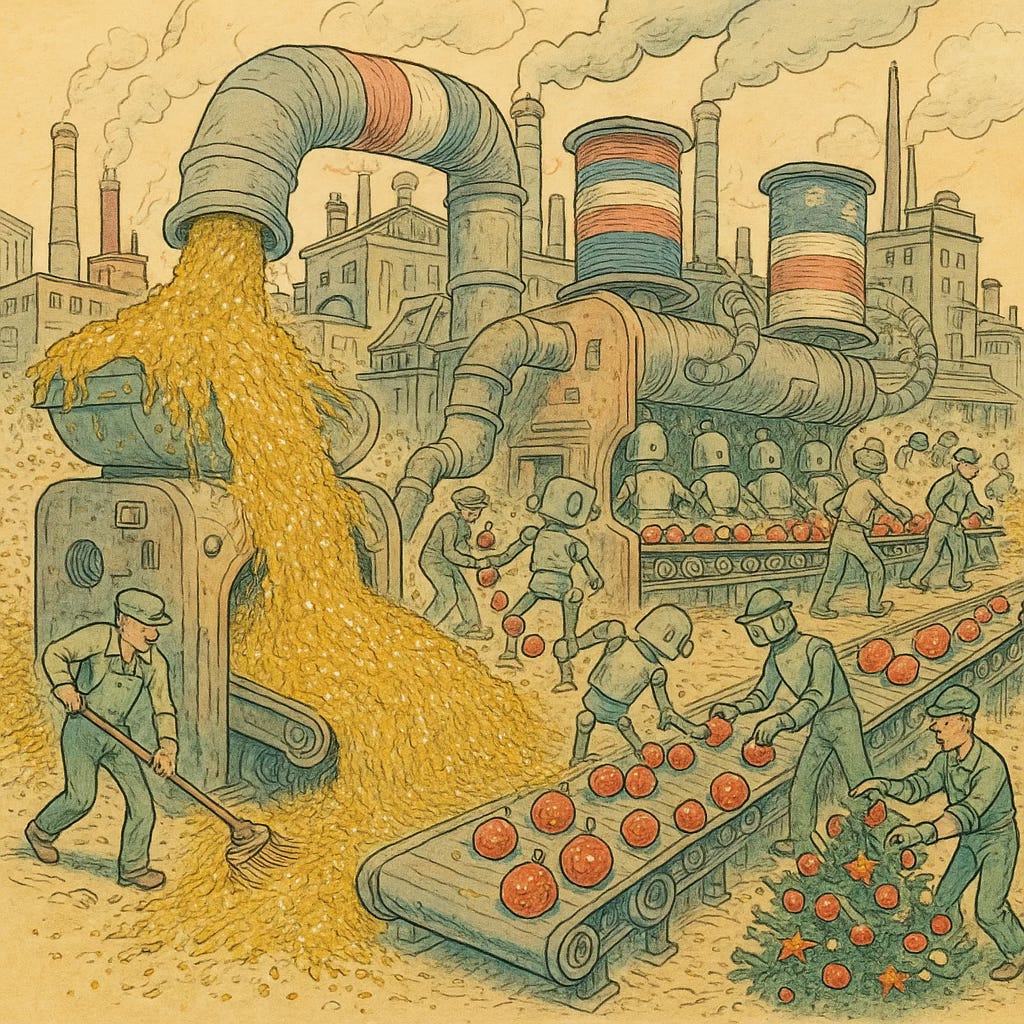
Every December, as suburban driveways morph into gaudy light shows, countless yards bear witness to a peculiar phenomenon: trees draped in metallic tinsel that glitters like a disco inferno—yet vanishes in a week, only to reappear the following year in sleeves of shed shards. It’s the annual rite of PVC and plastic festivity, imported en masse because nobody in America makes the stuff.
A Wonderland of Flimsy Trinkets
Between ornaments, artificial garlands and fake‑pine wreaths, the U.S. shelled out nearly $4.8 billion on holiday décor in 2023—some $4.3 billion of it from Chinese workshops. That’s roughly 88 percent of all “ornamental” goods flying across the Pacific, from tinsel strands so thin they might dissolve in winter rain to baubles that crack if you so much as glance at them too eagerly. It’s a stunning statistic: our nation of makers has ceded the simplest seasonal pleasures to offshore economies.
The Absurd‑But‑Ubiquitous Runner‑Up
Toys might claim the runner‑up spot—80 percent of playthings in U.S. stores are stamped “Made in China,” complete with the requisite plastic figurines and battery‑powered glow‑sticks. Yet at least they undergo safety testing; our seasonal tat arrives without so much as a regulatory wink. Easter‑basket grass, Halloween skeletons, disposable partyware—they too owe their existence to cost‑cutting overseas. Still, none match the yuletide glut of sparkly refuse.
Reshoring Tinsel: A Glitter‑Laden Pipe Dream
Imagine a Humble Factory™ in Albany, Georgia, churning out lamé strands by daylight, piping them onto spools by moonlight. Labour costs would eclipse any margin; environmental regulations alone could bankrupt the enterprise before the first flake of glitter hits the floor. And what would be the payoff? A product that hummocks in landfill by January, demanding storage until next winter’s fervour.
— Yet hope springs eternal: artisanal “Made in USA” tinsel—hand‑folded, small‑batch, and packaged in quaint kraft boxes—could find favour among the ritualistic gifters of heirloom nonsense. For a few hundred dollars a reel, one might drape a tree in patriotic sheen.
If the grandest reshoring ambition is to resurrect America’s prowess as the world’s chief manufacturer of holiday junk, let us salute the tinsel maker—those brave souls who’d chase fleeting sparkle for fleeting profit. In the end, the only true Made‑in‑USA glitter might be our collective chutzpah.